

Most growing businesses don’t actually have a software problem. They have a decision problem: buy SaaS, build custom, or combine both.
In 2026, this decision has become more strategic than ever. AI-assisted development lowers build friction, but that doesn’t mean “always custom” is suddenly the best move.
Why this decision is harder now
SaaS gives speed. Custom gives fit. Hybrid often gives both — if designed intentionally.
The real risk isn’t picking one category. The risk is making the decision without a framework.
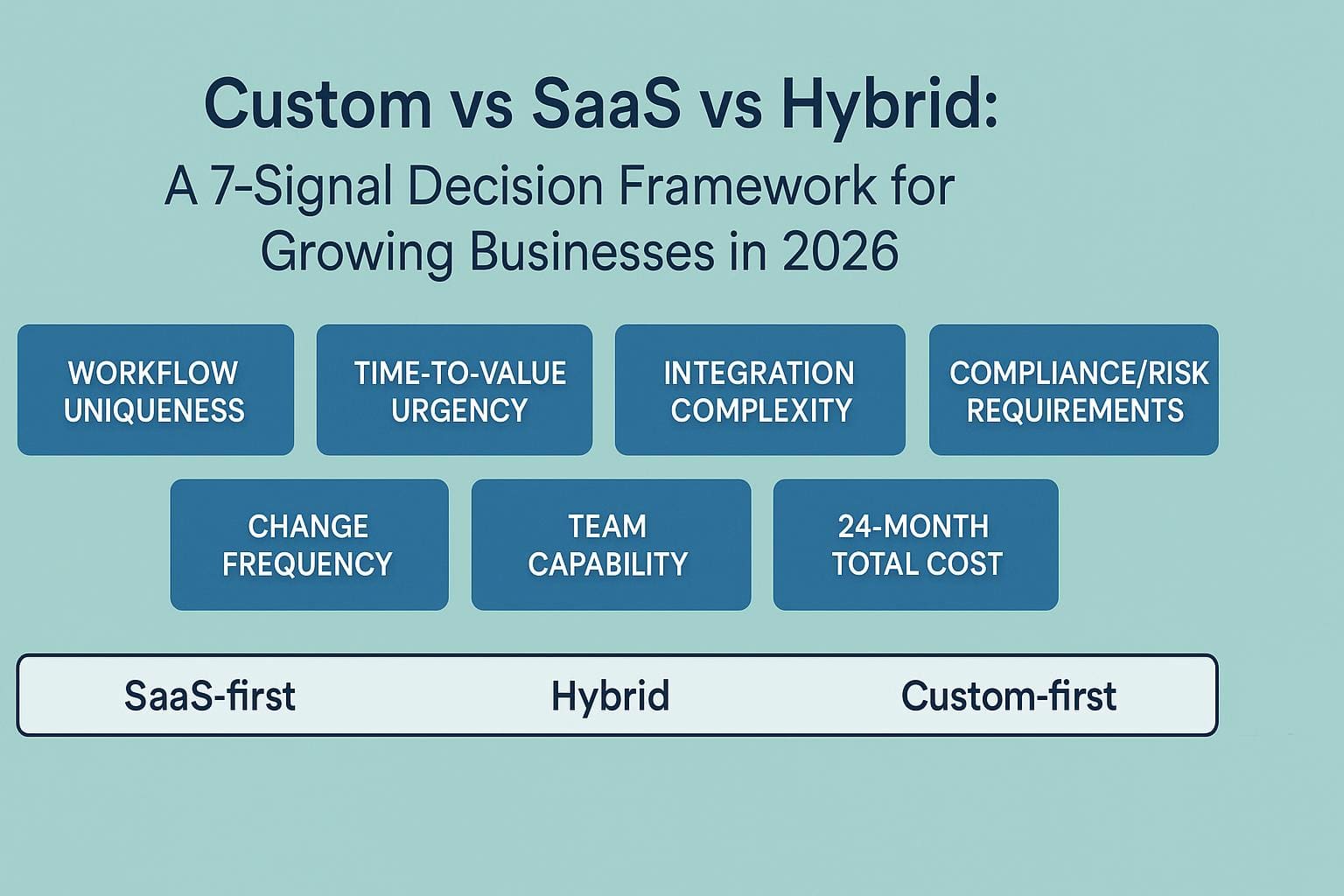
The 7 signals to evaluate first
1) Workflow uniqueness
If your process is materially different from the default market pattern, forcing it into generic software creates long-term drag.
2) Time-to-value urgency
If this initiative must produce value quickly, SaaS or hybrid may be the right starting point.
3) Integration complexity
When multiple systems must coordinate tightly, architecture quality matters more than feature checklists.
4) Compliance and risk requirements
Data controls, audit trails, and operational risk constraints often justify custom components.
5) Change frequency
If your workflow evolves often, flexibility and iteration speed become primary decision factors.
6) Team capability
Can your team own and evolve the system responsibly over time? Ownership reality should shape build-vs-buy choices.
7) 24-month total cost
Look beyond month-one cost: include licenses, integration overhead, retraining, inefficiency, and maintenance burden.
How to interpret outcomes
- SaaS-first: lower uniqueness + high urgency + moderate integration burden.
- Hybrid: mixed constraints, some differentiated workflows, significant integration demands.
- Custom-first: high uniqueness + high change frequency + high strategic leverage.
Bottom line
The winning approach in 2026 is not “always build” or “always buy.” It’s choosing architecture deliberately with a repeatable decision model.
If you’re evaluating your stack, Orchard 9 can help score your workflows and map the right SaaS/custom/hybrid path before you commit engineering and budget.