

Growing businesses have long lived with a frustrating software compromise: adopt off-the-shelf tools that are quick to launch but imperfect in daily operations, or pursue custom software that historically felt too expensive and slow.
That equation is changing. AI-assisted development is reducing implementation cost and helping teams build better-fit systems faster—without sacrificing strategic rigor.
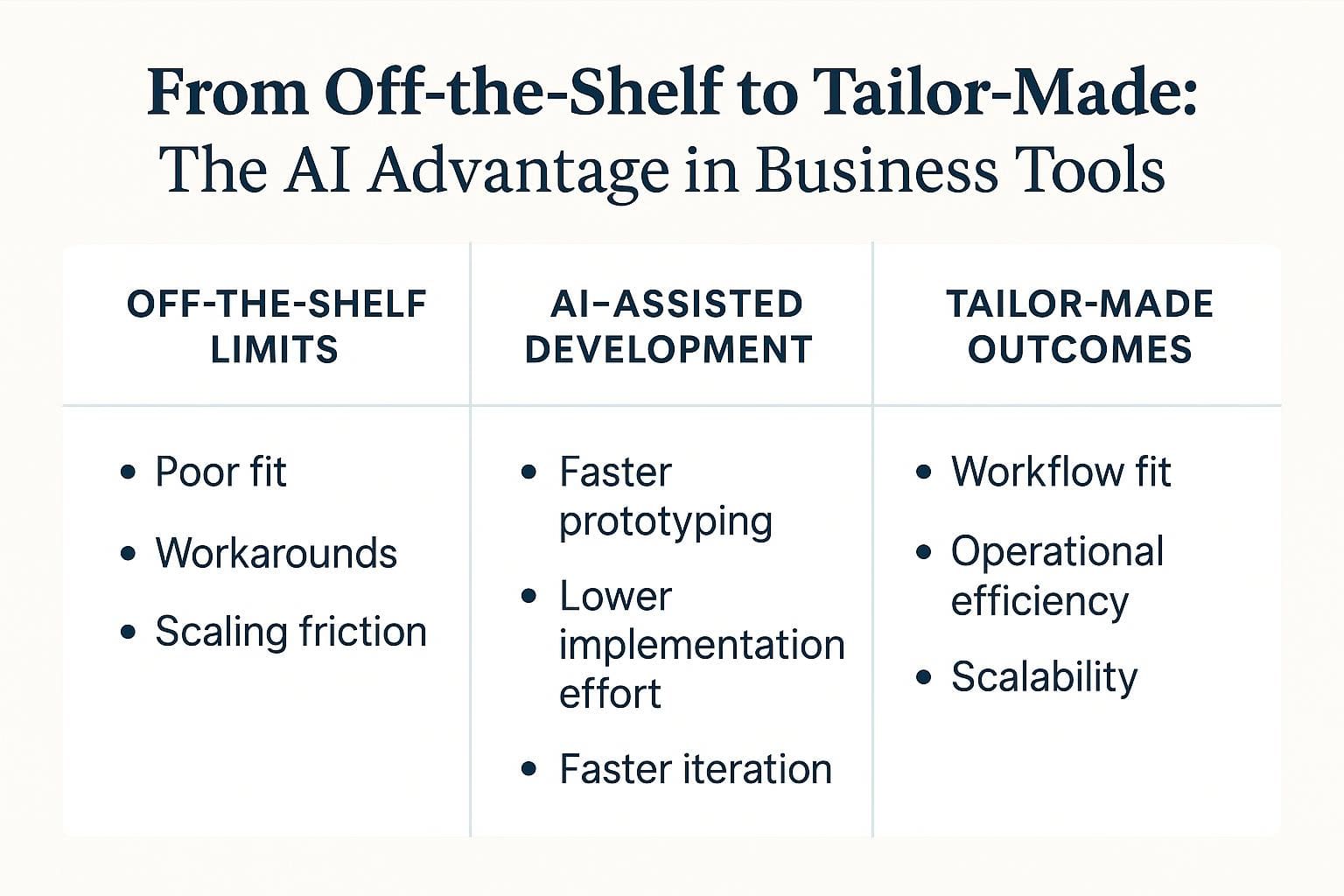
Why off-the-shelf software often breaks at the operations layer
Most off-the-shelf platforms are designed for broad market coverage, not your specific process. They are often excellent at generic workflows, but business-specific operations frequently require exceptions, workarounds, and duplicate effort.
- Manual handoffs between disconnected tools
- Spreadsheet-based fixes outside core systems
- Inconsistent data definitions across teams
- Reporting that reflects software structure—not business reality
What AI-assisted development actually changes
AI does not remove the need for architecture, product thinking, or quality assurance. What it changes is the economics of implementation: faster prototyping, lower repetitive build effort, and more iteration in the same budget window.
Where custom fit has the highest ROI
Custom software is most valuable where your process is a differentiator, not a commodity: workflow orchestration, automation layers, industry-specific operations, and decision-support interfaces.
Build vs buy is now a portfolio decision
For most companies, the best answer is hybrid: use mature platforms where standardization helps, and build custom modules where process uniqueness drives performance.
A practical decision framework
- Strategic importance
- Process variability
- Coordination cost
- Scalability pressure
High scores across these dimensions usually indicate where custom investment delivers outsized returns.
Bottom line
AI has shifted software from a binary cost decision to a strategic design decision. For many growing businesses, custom-fit systems are now economically viable.
If you are deciding between platform, custom, or hybrid, Orchard 9 can help map the right architecture for your workflow and growth stage.